All posts by Jeff Berns

Client Alert: The Biden-Harris Administration: What Energy and Telecommunications Policies Will It Likely Pursue?

January 27, 2021

The inauguration of President Joe Biden and Vice President Kamala Harris—coupled with the installation of a Democratic-majority Senate and House—means new directions for U.S. energy and telecommunication policy, and changes that are likely to impact our clients.  As the Biden-Harris Administration begins, we pause to offer a few thoughts on what we may expect over the next four years.  While we have no crystal ball, we do have decades of experience in Washington and we hope that our informed speculation will be helpful. We look forward to discussing—and experiencing with you—these momentous years for our nation.

Please contact any Spiegel & McDiarmid attorney if you have questions.

FERC Rejects ISO New England’s “Energy Security Improvements” Proposal

October 30, 2020

FERC issued an order on October 30 rejecting ISO New England’s proposed suite of “Energy Security Improvements” or “ESI.” Approval of ESI would have imposed enormous charges on New England consumers in return for dubious — if any — regional reliability/fuel security benefits. ISO New England filed the proposal in response to a FERC directive to adopt a market mechanism to address regional fuel security concerns.

Under ESI, New England ratepayers would have paid the region’s generators up to an additional $257 million dollars a year for three new day-ahead products, based on the hope that those day-ahead payments would encourage generators to procure fuel supplies months in advance. Our clients, Massachusetts Municipal Wholesale Electric Company, New Hampshire Electric Cooperative and Connecticut Municipal Electric Energy Cooperative, argued that ESI allowed insufficient time for the generators to purchase needed supplies. And, worse, the proposal was voluntary—meaning that generators could decide not to participate at times when the system need was most acute.

Spiegel attorneys Scott Strauss, Jeff Schwarz, Latif Nurani and Amber Martin Stone represented the three organizations in the case.

Strauss, Schwarz and Hopkins Publish Op-Ed on FERC’s Capacity Markets’ Effects on Clean Energy and Consumer Costs

August 27, 2020

Presidential candidate Biden and Congress are focused on solutions to the climate crisis. Billions of dollars in new investment will be needed. But money will not be enough. In our op-ed, “FERC’s Capacity Markets Limit Clean Energy and Cost Billions; It’s Time for Congress to Act,” published August 27, 2020, in Utility Dive, we argue that the fate of US efforts to transition to a clean energy economy depends on federal and state cooperation. But the federal government, through the actions of the Federal Energy Regulatory Commission, is actively undermining state programs. If not reversed, consumers will bear billions in unnecessary costs, as older, less environmentally-friendly plants remain online, contrary to state and citizen preferences. A recent House report recommends a fix to the problem, which should be pursued.

Chambers Again Recognizes Spiegel & McDiarmid LLP

May 5, 2020

Bogorad, Pomper, Strauss Highlighted

Spiegel & McDiarmid LLP thanks our clients for their continued support and confidence as reflected in the recognition the firm has recently received from Chambers USA.

For the seventh consecutive year, Chambers & Partners has recognized Spiegel & McDiarmid LLP as one of the nation’s leading law firms in the area of “Energy: Electricity (Regulatory & Litigation) — Nationwide.” Chambers also recognizes Cindy Bogorad, David Pomper, and Scott Strauss individually as among the top lawyers in that category. Chambers ranks “the world’s best lawyers and law firms based on in-depth, objective research” and extensive interviews with clients and colleagues. Their guide is considered the premier survey of attorneys and law firms in the country.  We are gratified by the comments we received from clients and others as reported in Chambers USA.  You may read the full review on Chambers’s website.

How FERC’s Peers Estimate Equity Costs

December 5, 2019

Spiegel partner David Pomper’s article, “How FERC’s Peers Estimate Equity Costs: A Deep Dive,” appears in the December 2019 issue of Public Utilities Fortnightly.  It went to press before FERC issued its Opinion No. 569, which accords with the article’s observation that earnings/book ratios do not represent the capital attraction cost of equity and should not be used to set allowed returns.  The article also provides insights on how FERC’s peers estimate the market-wide rate of return on equity.

Tim Lay Speaks at National and Texas Conferences on Recent FCC, Court and Hill Developments Impacting Local Governments.

November 22, 2019

Tim Lay spoke on panels at the annual conferences of the National Association of Telecommunications Officers and Advisors (NATOA) in Tampa, and the Texas Association of Telecommunications Officers and Advisors (TATOA) in Corpus Christi.

The topic of the NATOA conference panel was “Franchise Fees and ROW Management: What’s Left After the FCC’s New Rules?”  The topic of the TATOA panel was “Federal Update: FCC, Litigation, and Legislation Impacting Local Governments and the Communications Industry.”

Bogorad, Pomper, Schwarz and Strauss Named 2020 “Super Lawyers” and Bayne and Nurani Named “Rising Stars” in Energy & Natural Resources

November 15, 2019

Spiegel & McDiarmid LLP is proud to announce that Cindy Bogorad, David Pomper, Jeff Schwarz and Scott Strauss have been selected as 2020 Washington DC “Super Lawyers” in the practice area of Energy & Natural Resources, and Jeff Bayne and Latif Nurani have been newly selected as “Rising Stars.”

Super Lawyers, a Thomson Reuters business, is a rating service of outstanding attorneys from more than 70 practice areas who have attained a high degree of peer recognition and professional achievement.  Super Lawyers are selected through a process involving independent research, peer nominations and peer evaluations.

You may view the write-ups at here.

Daniel I. Davidson

September 13, 2019

It is with great sadness that we announce the death of our former partner, Daniel Davidson, who spent forty-five years of his legal career with Spiegel & McDiarmid. We remember Dan as an invaluable colleague and wonderful friend, who had a unique gift for crafting the right legal argument, locating the most apt case, and recommending the best mystery novels.

Dan was a 1959 graduate of the Columbia School of Law, where he was a member of the Law Review. After graduation, he clerked for two Second Circuit Judges: Harold Medina and Learned Hand.

Prior to his career as an energy lawyer, Dan worked in New York City, and for several years thereafter, at the U. S. State Department, where he was a staff member at the National Security Council and served as a delegate to the Paris Peace Talks to end the Vietnam War. Outside of the office, Dan was a longtime contributor of op-eds and book reviews to the New York Times, Atlantic, Financial Times, Economist and the Washington Post.

Our California clients remember Dan for his role in the case averting an exponential (and for some clients potentially catastrophic) proposed transmission rate increase by PG&E against the Western Area Power Administration and for litigation over access to transmission service from the Pacific Northwest that was the first successful enforcement of the antitrust conditions in a nuclear license.

More generally, Dan was instrumental in a range of complex matters. Perhaps most noteworthy was his and the firm’s success in the carbon fiber industry price fixing and qui tam litigation.

Dan died peacefully at home, with his wife Susan and his daughter Jill beside him. Our hearts are with them at this difficult time.  According to his wishes, no services will be held, but there will be a memorial gathering at a later date.

Throughout his career of law and public service, Dan was guided by a strong commitment to fairness and justice.  We will miss him greatly.

Horwood, Lay Give Updates at Annual Conferences of National Community Media Organizations

July 30, 2019

Spiegel partners Jim Horwood and Tim Lay both made presentations at the Alliance for Community Media 2019 Annual Conference in Portland, Oregon on July 10.  Tim spoke at the session on “Federal Policy Developments: What You Should Know and Do.”  Jim spoke at the session on “State Policy Developments: What Are Good and Bad Developments to Monitor.”

Jim also gave a report on the “Legal Report on Court and FCC Decisions and Activities During 2018–2019” at the Alliance for Communications Democracy 2019 Annual Meeting on July 11. A copy of the handout is linked below.

Spiegel Partner Pomper Responds to Article Criticizing Serial ROE Complaints

June 7, 2019

David Pomper responded to a recent article in the Public Utilities Fortnightly which faulted “successive customer complaints against the same ROE.”*  In his letter to the editor in Fortnightly’s June issue, David provides some background on the 1988 Regulatory Fairness Act and its application of symmetry between utility rate increase filings under Federal Power Act section 205 and complaints requesting rate decreases under the companion section 206.  He concludes that the Federal Energy Regulatory Commission “should focus on a merits comparison between the rates that customers pay and study-period costs.”

You can read Mr. Pomper’s letter at the link below.

_______

* Carmen Gentile, Time to Put the Kibosh on Pancaking Section 206 Complaints: FERC Must Act, Pub. Utils. Fortnightly, Apr. 2019, at 42. Link (password required).

FMPA Wins Complaint Against Duke, Restoring Queue Positions

May 16, 2019

On May 16, 2019, FERC granted a Florida Municipal Power Agency (FMPA) complaint against Duke Energy Florida (DEF), reinstating FMPA’s previously submitted requests for transmission service to supply its members with power generated from the Poinsett Solar Facility, a NextEra 75 MW solar installation that is part of the largest solar project in Florida.

FMPA requested transmission service from DEF for its All-Requirements Project and member cities Bartow, Wauchula, and Winter Park in September 2018.  Because NextEra’s interconnection request for the Poinsett Solar Facility was still pending, DEF rejected the transmission service requests based on its unwritten policy requiring an executed generator interconnection agreement before a transmission service request can be submitted.  DEF’s rejection of these requests resulted in FMPA losing its transmission queue position, advantaging other transmission requests, including those of DEF.  FMPA’s complaint asked FERC to find that DEF had violated its OATT and other requirements, and to restore the wrongfully denied transmission service requests and associated queue positions.

Three and a half months after FMPA filed the complaint, FERC granted it.  FERC found that DEF’s rejection of the FMPA transmission service requests violated DEF’s tariff, its business practices, the Federal Power Act, and FERC precedent—every ground on which FMPA had based its complaint.  FERC also granted FMPA’s requested remedy: restoration of the transmission service requests and their queue positions.

FMPA’s complaint, filed by Spiegel attorneys Cindy Bogorad and William Huang, can be found here, and FERC’s Order can be found here.

Court Relies on Scholars’ Amici Brief in Allowing Foreign Emoluments Case to Go Forward

May 1, 2019

On May 1, 2019, the U.S. District Court for the District of Columbia rejected the President’s motion to dismiss a suit brought by members of Congress alleging that the President has violated the Foreign Emolument Clause of the Constitution.  Spiegel attorneys Katharine Mapes and Jeffrey Bayne represented amici curiae Separation of Powers Scholars.  The amici brief, which can be read at the link below, argued that adjudication of this case is consistent with the separation of powers set forth in the Constitution.  The District Court cited to Separation of Powers Scholars’ amici brief in rejecting the President’s argument that the court should exercise “extreme equitable restraint” and decline to hear this case.  The court agreed with amici curiae Separation of Powers Scholars that this case would not distract the President from his official duties, because compliance with the Foreign Emolument Clause is part of a President’s official duties.

Port of Portland Prevails in Airport Revenue Use Case

April 23, 2019

On April 23, 2019, the United States Court of Appeals for the DC Circuit affirmed the Federal Aviation Administration’s decision denying an administrative complaint brought by the Air Transport Association of America d/b/a Airlines for America (A4A) against the Port of Portland.  At issue was whether the Port, which owns and operates the Portland International Airport, is violating federal law when paying certain utility charges imposed by the City of Portland as part of the Airport’s operating costs.

The Airport sits within City limits and receives water and sewer services from the City.  The Airport and City are independent entities.  The dispute arose when the City began imposing separate line item charges as part of its combined sewer/stormwater/water bill to cover the cost of managing stormwater on public property throughout the City, and the cost of participating in the environmental investigation and cleanup of a Superfund site on the banks of the Willamette River.  These costs are allocated by formula to all City water and sewer utility ratepayers, including the Port as the Airport’s owner.

A4A argued that airport revenues could not be used to pay for the disputed utility charges because the charges are being imposed to pay for things that are not directly or substantially related to PDX, or for which PDX receives no value, in violation of the federal airport revenue use restrictions.  Alternatively, the airlines argued that the disputed utility charges are an impermissible tax or fee on air transportation, in violation of the federal Anti-Head Tax Act.

The Court held that FAA correctly determined that the disputed components of the utility fees were imposed to recover general costs of the City utility, and, as calculated and assessed uniformly to all ratepayers based on a common cost allocation method, are operating costs of the Airport.  The Court explicitly rejected the notion that operating costs of an airport must be directly and substantially related to the air transportation of passengers or property.  The Court likewise rejected A4A’s argument that, under federal law, airport operating costs must reflect the value of services and facilities provided to the airport.  Finally, the Court rejected the notion that the disputed charges were impermissible taxes or fees on air transportation.

Spiegel partners Pablo Nüesch and Peter Hopkins represented the Port of Portland before FAA and the Court of Appeals.

FAA’s Final Agency Decision can be found here, and the Court’s decision denying the petition for review here.

Supreme Court Declines to Hear Appeal of New York Subsidies Case

April 15, 2019

On April 15, the U.S. Supreme Court denied a petition for writ of certiorari, thereby ending a constitutional challenge brought by a group of fossil‑fueled generators against New York State’s zero-emissions credits (ZECs) program.  The ZEC program provides production‑based subsidies to certain financially challenged nuclear plants, to keep those plants operating until new renewable electricity supplies can meet a greater percentage of the state’s energy needs.  The ZEC program is part of the state’s “Clean Energy Standard,” an initiative designed to reduce New York’s greenhouse gas emissions 40% by 2030.

The Supreme Court declined to review a Second Circuit decision upholding the ZEC program in Coalition for Competitive Electricity v. Zibelman, 906 F.3d 41 (2d Cir. 2018).  The Petitioners, who want to see the nuclear plants retire so that their facilities can run more often and earn greater revenues, sued in federal district court arguing that the New York program was field- and conflict‑preempted.  Petitioners claimed that the ZEC program was akin to a Maryland generation‑support program which the Supreme Court struck down on preemption grounds in Hughes v. Talen Energy Marketing, LLC, 136 S. Ct. 1288 (2016).  The Second Circuit affirmed a district court ruling dismissing the complaint.  The district court found no statutory or equitable basis for plaintiffs to bring their Federal Power Act preemption claims in court, holding that relief must be sought instead from the Federal Energy Regulatory Commission.  The district court also dismissed because it found, on the merits, no basis for finding either field or conflict preemption or a violation of the Dormant Commerce Clause.  The Second Circuit affirmed the dismissal on the merits. With the Supreme Court’s action, the Second Circuit ruling stands.

Spiegel & McDiarmid LLP attorneys Scott H. Strauss, Peter J. Hopkins and Jeffrey A. Schwarz represented New York in all phases of the case. You may read New York’s opposition to the writ of certiorari at the link below.  The case is Electric Power Supply Association v. Rhodes, No. 18-879. The same three attorneys also represented the State of Maryland before the Supreme Court and Fourth Circuit in Hughes v. Talen Energy Marketing.

FERC Grants Complaint by Owensboro, Kentucky; Orders Refunds Exceeding $5.5 Million

March 12, 2019

In Owensboro Municipal Utilities v. Louisville Gas & Electric Co. and Kentucky Utilities Co., 166 FERC ¶ 61,131 (Feb. 21, 2019), Spiegel & McDiarmid LLP successfully enforced an obligation worth about half a million dollars each month to its client, Owensboro Municipal Utilities (“Owensboro”).

In 2006, Louisville Gas & Electric and Kentucky Utilities (“LG&E/KU”) were allowed to leave what is now the Midcontinent Independent System Operator (“MISO”), on the condition that they shield their on-system transmission customers, such as Owensboro, from having to pay an extra (“pancaked”) transmission charge to move power over the resulting MISO-LG&E/KU border.  LG&E/KU complied with that condition by entering into a contract and rate schedule under which, among other things, it reimburses Owensboro for transmission access charges incurred to bring power from within MISO to that border.  (In ongoing proceedings in a different docket, LG&E/KU are seeking to terminate that reimbursement obligation; Owensboro and other Kentucky Municipals maintain that it remains in the public interest.)  With the impending retirement of its local coal-fired power plant, Owensboro determined it would need to procure replacement power supply from outside LG&E/KU and a firm transmission path to bring that power to the LG&E/KU border.  Through parallel procurement processes, it purchased firm power from MISO member Big Rivers Electric Cooperative, and reserved a 115 MW firm path from within MISO to the MISO-LG&E/KU border.  But when Owensboro submitted invoices to LG&E/KU requesting reimbursement for MISO’s export transmission access charges, LG&E/KU denied reimbursement, claiming that Owensboro didn’t need power from within MISO and had reserved the export path before its contract with Big Rivers was signed.  Through Spiegel & McDiarmid, Owensboro filed a complaint seeking to enforce LG&E/KU’s reimbursement obligation.  FERC granted the complaint, ordered LG&E/KU to reimburse Owensboro’s charges for so long as the reimbursement tariff remains on file with FERC, and ordered refunds with interest for the twelve months of previously withheld reimbursements.  The refunds are expected to exceed $5.5 million.

Spiegel Attorneys Defend Constitutionality of PEG Access Channels Before Supreme Court

January 18, 2019

Spiegel attorneys Jim Horwood, Tim Lay, Peter Hopkins, Jeff Bayne, and Amanda Drennen filed an amicus brief with the U.S. Supreme Court defending the constitutionality of the thousands of public, educational, and government (“PEG”) access cable channels that serve communities across the United States.  The brief, submitted on behalf of the Alliance for Community Media, the Alliance for Communications Democracy, and the National Association of Telecommunications Officers and Advisors, rebuts the arguments of NCTA—The Internet & Television Association, the cable industry’s trade association. NCTA argued in an earlier amicus brief that PEG access requirements authorized in the 1984 Cable Act unconstitutionally infringe on the free speech rights of cable operators.  The firm’s amicus brief points out that NCTA’s arguments were not raised in the courts below or by the parties to the case and therefore should not be considered by the Court. The brief then notes that, should the Court nevertheless consider NCTA’s arguments, they are inconsistent with both the facts and legal precedent.

A copy of the brief is available at the link below.

Latif Nurani Becomes a Spiegel & McDiarmid LLP Partner

January 1, 2019

Spiegel & McDiarmid LLP is pleased to announce that Latif M. Nurani  has become a Partner in the firm.  Latif has been with Spiegel & McDiarmid since 2011.

Latif’s practice focuses on regulatory and policy issues related to electric reliability, market design and transmission rates.

He represents municipal utilities, joint action agencies, and state agencies before the Federal Energy Regulatory Commission and federal courts.  He also advises clients on compliance with the North American Electric Reliability Corporation (“NERC”) electric reliability standards and cybersecurity standards.

A graduate of the Columbia University School of Law, Latif is admitted to the bars of the District of Columbia and the State of New York.  You can read more about his practice and background here.

Latif Nurani

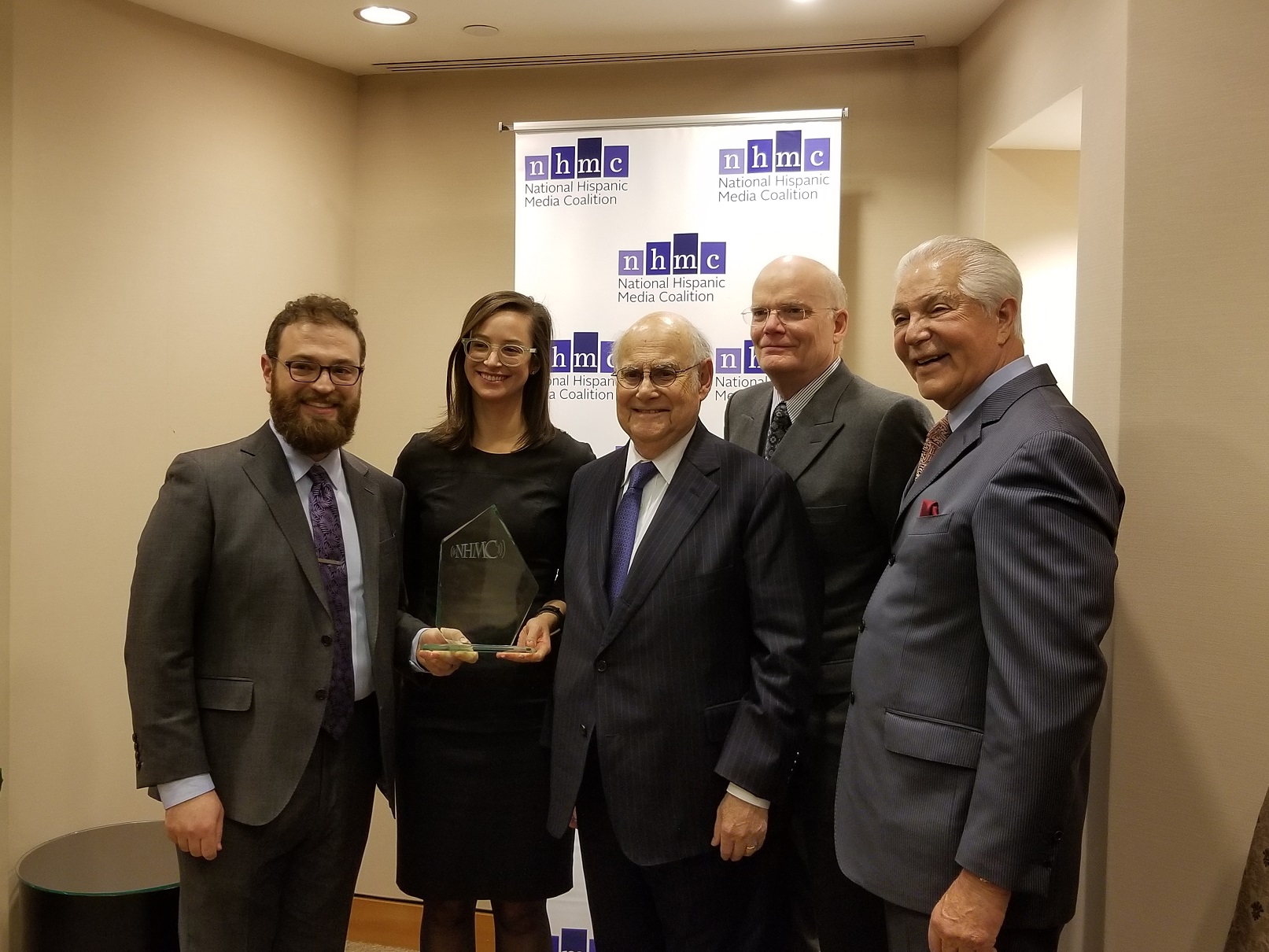
Spiegel Attorneys Honored by NHMC

November 28, 2018

The National Hispanic Media Coalition (NHMC) has selected Spiegel & McDiarmid LLP to receive its 2018 Impact Award for Outstanding Advocates.  The award “recognize[s] policymakers that are working to bridge the digital divide and enact policies that protect the interests of Latinos and other people of color.”  According to NHMC, Spiegel’s “pro bono representation in the Net Neutrality litigation has allowed NHMC to elevate the voices of Latinos and other people of color who struggle with affordable internet access which has far-reaching consequences on education, civic participation, economic, and healthcare outcomes in marginalized communities.”  The honor was bestowed at NHMC’s 9th annual Impact Awards Reception held November 28, 2018, in Washington, D.C.

Spiegel attorneys Jim Horwood, Tim Lay, Jeff Bayne and Kat O’Konski represented NHMC in the Net Neutrality litigation.

Spiegel Attorneys Honored by NHMC

Jeff Bayne, Kat O’Konski, Jim Horwood and Tim Lay with Alex Nogales, President & CEO of the The National Hispanic Media Coalition.

New York Prevails in Defense of Zero-Emission Credits

September 27, 2018

On September 27, 2018, in Coalition for Competitive Electricity et al. v. Zibelman et al.,* the Second Circuit upheld New York’s zero-emissions credits (ZECs) program, a component of its Clean Energy Standard and larger energy reform plan to reduce greenhouse gas emissions 40% by 2030. New York’s ZEC program aims to preserve the continued operation of nuclear generators, which do not emit carbon dioxide, until renewable sources of energy can meet a greater percentage of the state’s energy needs.  The ZEC price is based on the social cost of carbon, and is set by the New York Public Service Commission every two years. Qualifying nuclear generators are awarded a ZEC for each MWh of electricity they generate (subject to a cap), in addition to whatever revenues the facility receives for selling the electricity.

Plaintiffs, a group of generators and generator trade groups, alleged that the program was preempted by FERC’s authority over wholesale electricity sales and contrary to the U.S. Constitution’s Commerce Clause. Spiegel attorneys Scott Strauss, Peter Hopkins, and Jeffrey Schwarz defended the ZEC program, and moved to dismiss the complaint. A key question was how to interpret and apply the U.S. Supreme Court’s 2016 decision in Hughes v. Talen Energy Marketing, LLC, in which attorneys Strauss, Hopkins, and Schwarz defended a Maryland generation-support program. In its July 2017 ruling, the U.S. District Court of the Southern District of New York read Hughes as a narrow limitation of broadly preserved state power to choose the technologies and fuels used to produce electricity for state energy consumers.

Ruling on Plaintiffs’ appeal, the Second Circuit agreed with the district court that New York’s ZECs are not “field preempted.” Unlike the program in Hughes, New York did not require generators to participate in a FERC-regulated wholesale electricity market and did not guarantee receipt of a rate for wholesale sales distinct from the wholesale market clearing price. The court also upheld ZECs against “conflict preemption” claims because the program did not cause clear damage to FERC’s goals of using auctions to set wholesale prices. The court recognized that FERC’s reliance on wholesale auctions operates against a “background assumption that the [Federal Power Act] establishes a dual regulatory system between the states and federal government and that the states engage in public policies that affect the wholesale markets.” The court found it unnecessary to consider the dormant Commerce Clause arguments, because the plaintiffs lacked standing to bring the claim.

_______

*Spiegel & McDiarmid LLP attorney Scott H. Strauss argued the case for the Chairman and members of the New York Public Service Commission, with Spiegel attorneys Peter J. Hopkins and Jeffrey A. Schwarz on the brief.

Spiegel & McDiarmid Attorneys Represent the National Hispanic Media Coalition in Challenging the FCC’s Net Neutrality Repeal

August 20, 2018

On August 20, 2018, a group of public interest organizations, internet companies, and competitive carriers dedicated to protecting an open internet filed their initial brief in the court challenge to the FCC’s repeal of its prior open internet rules.  The brief is available at the link below.  Spiegel & McDiarmid attorneys Jim Horwood, Tim Lay, Jeff Bayne, and Kat O’Konski are on the brief, serving as pro bono counsel to Petitioner National Hispanic Media Coalition (“NHMC”), a non-partisan, non-profit, media advocacy and civil rights organization.

In 2015, the FCC adopted open internet rules that, among other things, barred paid prioritization and prohibited broadband internet service providers from blocking or throttling users’ access to lawful Internet content.  In the spring of 2017, however, the FCC reversed course and proposed repealing the 2015 rules.  NHMC submitted several Freedom of Information Act requests for materials concerning informal consumer complaints submitted to the FCC under the 2015 open internet rules. NHMC also requested that those materials be included in the record of the FCC’s proceeding and that the public be given the opportunity to comment on them.  Although the FCC had not produced all of the materials NHMC requested, it nevertheless issued its order repealing the 2015 open internet rules protections earlier this year, and that order also denied NHMC’s motion to include those open internet complaint materials in the record.  Among the arguments Petitioners raise in their appeal of the FCC’s order is that the FCC violated the Administrative Procedure Act by excluding these relevant consumer complaint materials from the record.